culture
AI And The End of Authentic Human Lives
Colin Yuan
One year ago, The New York Times published a video called “I Let AI Make Every Decision”: chatbots planned out the journalist’s week, told her what to wear and eat, and picked out a new paint color for her office. While the experiment may seem lighthearted, I believe it marks the possibility of something deeply concerning: for the first time in history, every one of us, with AI, can live a life entirely removed from the burden of making authentic choices—a life that is not, properly speaking, our own. Offloading existential burden is logical to humans. We’re predisposed to want to avoid making hard choices in life. Kierkegaard describes the human experience of living (i.e., making decisions) as one of “angst,” or anxiety. In particular, our freedom to decide how we live is “dizzying,” and we are often paralyzed by it. For centuries, we sought the transcendent, such as divine will, laws of nature, and moral truths, to guide our actions and justify their consequences. Yet, this system of values collapsed when the Christian God lost its influence in the Western world; now, man is left to ground his own existence in the world and is forced to be responsible for it, no matter how daunting it may seem. In this article, I argue that the corruption of individual choice-making could lead to the end of authentic lives and massive profits for tech companies not seen since the medieval Catholic Church.
To understand why AI is an attractive proposition for the modern man, we need to understand Nietzsche’s “Will to Power” as the manifestation of man struggling to define his existence in a world where there are no values readily available. As Heidegger claims, with the “transcendent,” the “beyond,” and “heaven” abandoned, man is left with only “earth” to ground his new metaphysics that would establish the new order (E.N. pg.8). A new, modern metaphysics must then be founded upon man’s own values, as the new order cannot be based on divine laws or moral truths (E.N. 8). The kind of man who endures in this new world is the “Overman” (Übermensch), because he is the only kind of being capable of enduring a reality without external meaning by imposing his own will upon the earth. Thus, he becomes self-sufficient in granting himself as his grounds for truth and reality (E.N. pg.82, 9). Put differently, man lives a nihilistic life without some higher absolute values to attain. But he, faced with the collapse of transcendent values, has only himself and his reality to grasp onto. He then necessarily founds a new faith in himself that strives for the “accruing of power by power for its own overpowering,” which tangibly means building assurance in his power over reality, knowledge, and stock of resources (E.N. 8). Ultimately, it takes a man who can put himself at the absolute center of power and reality as his own lawgiver to live meaningfully.
In a post-transcendental world devoid of higher values, man learned to live with the bitter truth of life’s meaninglessness through various psychological states and forms of the Apollonian and Dionysian. Nietzsche delineates the psychological duality of human experience through the concepts of the Apollonian and the Dionysian, which are directly related to the Greek gods Apollo and Dionysos. He describes the concept of the Apollonian as the “waking” half of our existence, representing structure and order, while the Dionysian represents the “dreaming” half, characterized by chaos, intoxication, and primal unity. In our daily lives, the "former strikes us as being the more privileged, important, dignified, and worthy of being lived.” However, a life restricted to this structured way of being is incomplete. Nietzsche argues that man is "bound to feel more than this: his entire existence, with all its beauty and moderation, rested on a hidden ground of suffering and knowledge which was exposed to his gaze…by the Dionysiac”(BT 27). The two forces are deeply interdependent, for "Apollo could not live without Dionysos”(BT 27).
Engaging with various forms of art allows humanity to balance these waking and dreaming states. For instance, music specifically serves a profound function because it “refers symbolically to the original contradiction and original pain at the heart of the primordial unity, and thus symbolizes a sphere which lies above and beyond all appearance”(BT 39). This Schopenhauerian-inspired idea, put differently, suggests that music dissolves our sense of self and places us in a state of unity, where we transcend individual experiences (e.g., having an ego, suffering) and enter a higher realm, temporarily dissolving everyday appearances. Revelries like concerts, raves, and festivals are very much in the spirit of this idea. Furthermore, dramatic tragedies in which the hero dies function to “give way to an overwhelming feeling of unity which leads men back to the heart of nature”. By watching a great hero die, we are traumatically reminded that our individual selves are fragile and temporary. However, this trauma breaks our ego and reconnects us to the “eternal life” of the universe. We leave the theater feeling powerful not because we survived, but because we remembered that we are part of something that cannot die. This in turn provides the audience with a necessary “metaphysical solace”(BT 39). Without the solace that art affords us, the stark realization of life’s meaninglessness “prompts man to see only what is terrible or absurd in existence wherever he looks; now he understands the symbolism of Ophelia’s fate, now he grasps the wisdom of the wood-god Silenus: he feels revulsion”(BT 40). In this state of existential nausea, art becomes essential because it “alone can re-direct those repulsive thoughts about the terrible or absurd nature of existence into representations with which man can live”(BT 40). Through this mechanism, the “disgust at absurdity is discharged by artistic means,” fulfilling art’s proper and vital role in human life (BT 40).
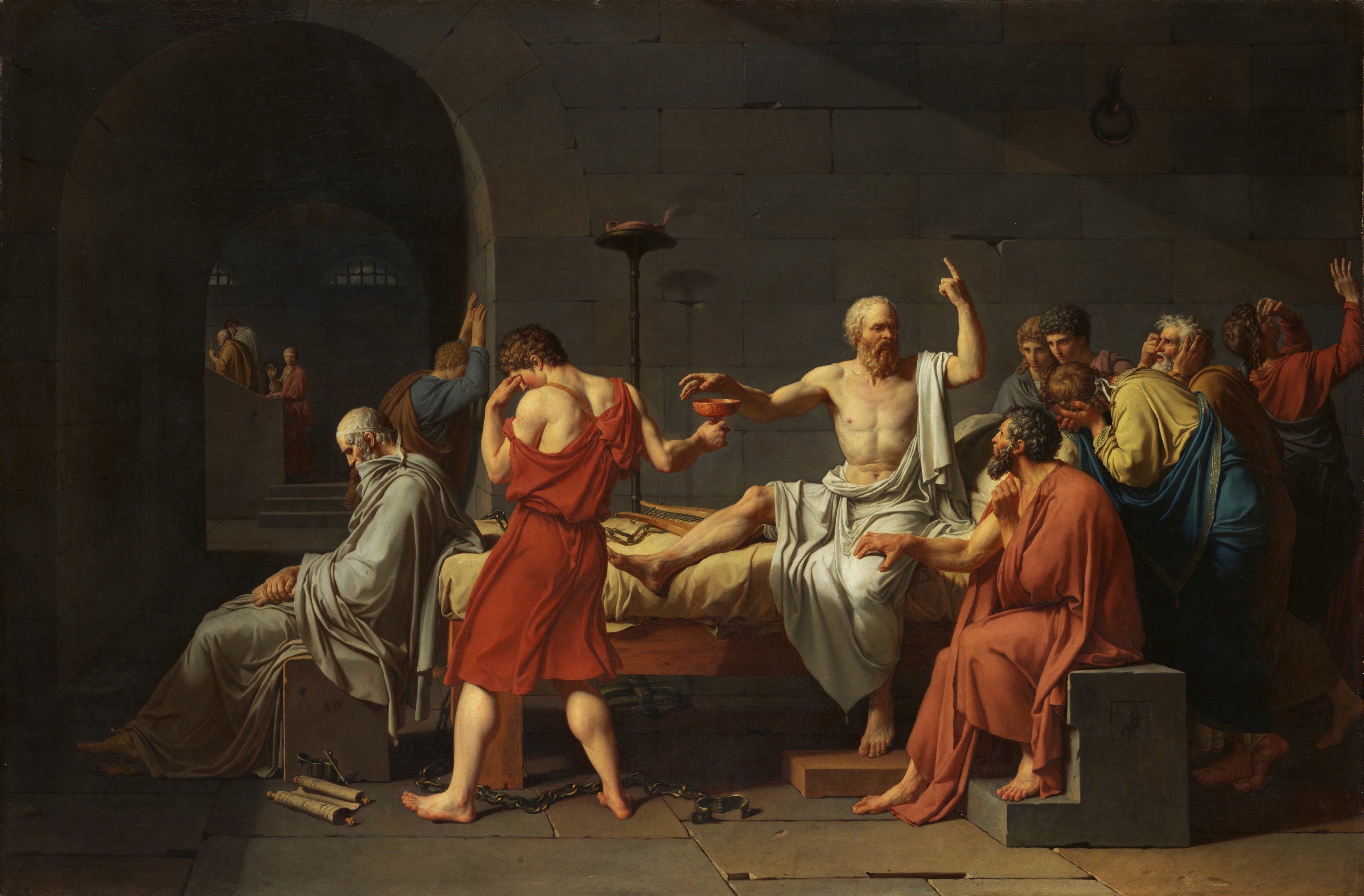
Yet Socrates, around 470 BCE, ushered in the modern era that shifted the emphasis away from the pursuit of great art to truth and knowledge as the way to deal with the meaninglessness of life: he suggested that only truth can make us virtuous and attain “bliss in existence” (BT 75). In this worldview, Greek tragedy, which stood as the “expression of the Apolline and the Dionysiac,” was relegated to the category of “flattering arts,” meaning Socrates viewed it as representing a pleasant but not useful activity. As a result, in the rigorous pursuit of truth, he told his disciples to “keep themselves strictly away from such un-philosophical stimulants.” This rejection of the artistic was so absolute that he told Plato to “burn his poetry so that he could become a pupil of Socrates”(BT 68). In Socrates’ conception of a meaningful existence, the archetype of the ideal life changes. Nietzsche notes that “the virtuous hero must now be a dialectician; there must now be a necessary, visible connection between virtue and knowledge, faith and morality.” This was a total intellectual commitment that required one to surrender all activity outside of the pursuit of theory and knowledge. Thus, Socrates “appears to us as the first man who was capable, not just of living by the instinct of science, but also… of dying by it,” referring to the image of the Dying Socrates. The painting imagines the ideal “of a man liberated from fear of death by reason and knowledge” and serves as “the heraldic shield over the portals of science.” Visually, this is seen in Socrates’ solace while sitting on his deathbed among friends and disciples who worry. Socrates is thus the epitome of the idea that knowledge, not art, brings us security and contentment, even in the face of imminent death.
AI stands as the epitome of the Socratic archetype of the theoretical man, defined by an insatiable desire to be knowledgeable and certain about the world. The theoretical promises of Artificial General Intelligence (AGI), which equals human cognitive abilities, and Artificial Superintelligence (ASI), which surpasses them, appeal to this desire because they ostensibly eliminate all uncertainty in one’s life. By promising unlimited abundance and total knowledge for humanity, these technologies imply the rebirth of a transcendent, God-like entity. Consequently, man unloads the burden of his “will to power” onto a machine, much like our prior faith in religion and Greek Gods. In this new “religion”, AI companies become bishops while their chatbots function as priests.
To grasp the gravity of this shift, we need to first understand the historical function of the priesthood as the intermediary between divine truth and the common man. In the Catholic tradition, the priest acted as a necessary mediator between the divine and the secular. He possessed the exclusive authority to interpret the will of God and to prescribe the specific actions required for salvation. Upon hearing a confession, the priest assigned penance, which usually consisted of a mandatory set of acts, prayers, or sacrifices required to satisfy the demands of divine justice. This dynamic created a psychological dependency where the ordinary individual, terrified by the angst regarding their own spiritual fate, surrendered their agency to the institution since the priest prescribed existential answers. Consequently, the layperson bore only the burden of obedience to the prescription. In this system, the validity of a life and the safety of a soul were entirely contingent on adherence to the mediator’s instructions.
The Church’s monopoly on truth and salvation inevitably transformed people’s psychological dependency on faith into a mechanism for the immense accumulation of wealth through the sale of indulgences, which reduced the time that sinners spent in Purgatory—a place for undergoing purification before one enters heaven. The institution sold indulgences through a “Treasury of Merit”, a doctrine that proposed that the spiritual economy of the Church possessed a vast reserve of “credit” generated primarily by the infinite value of Christ’s sacrifice on the cross. The Church claimed the exclusive right to sell withdrawls from this treasury to anxious sinners for a price, which famously culminated in the campaigns of Johann Tetzel in the early 16th century to fund the construction of St. Peter's Basilica. Tetzel explicitly marketed indulgences through a rhyming jingle that said “as soon as the coin in the coffer rings, the soul from purgatory springs.” This reduction of the metaphysical weight of choice-making down to a financial transaction secured centuries of economic dominance for the Church, which owned an estimated one-third of all land in Europe by the time of the Reformation. Essentially, they acted as a transnational state with the monopoly power to tax people on the “service” of salvation.
AI can dictate what we should believe and do because we trust its answers by way of its sheer intelligence and breadth of knowledge. It effectively functions as an all-powerful priest or oracle for the modern age. In this emerging paradigm, tech companies offer “faith-as-a-service” (FaaS) plans through chatbots to billions of people who look to remove the modern “sin” of uncertainty and inefficiency from their lives. The idea of FaaS derives from software-as-a-service (SaaS), which has existed for many decades, where software is licensed on a subscription basis and centrally hosted. It rose to popularity in large part because it provides predictable, recurring revenue and broad scalability since the cost to offer the same service to another customer is negligible. If you have apps like Slack or Adobe Photoshop, these are all examples of SaaS. For tech companies, SaaS gives them two key advantages: the first is the promise of improved efficiency or increased productivity, regardless of whether you understand the software fully or not. Meaning by simply subscribing and having access to the software, you gain reassurance of your own productivity and believe it has increased because you have the software. The second advantage is that you develop a continuous relationship with the company: if you purchase the software once, it is just a transaction; but if you subscribe to the software, you’re constantly receiving updates and checking in with the software. In this way, the company is constantly giving you affirmations and receiving your trust in return.
FaaS will build upon this subscription model and develop under today’s guise of “personal assistants” and “AI agents” into priests who prescribe readily-available values, goals, and choices for your life. In the face of AI’s superhuman intelligence and breadth of knowledge, users will be hard pressed to reject its authority and influence over them, and eventually succumb to AI’s dominating role as their life’s mediator. In the same way that religion enters one’s life with the promise of a better life, tech companies have used the promise of optimization and efficiency as the secular version of “salvation.” It appeals to our Socratic, theoretical selves who believe that more knowledge, certainty, and resources (like time and money) is good since it makes us powerful. Today, AI already optimizes our schedule and emails to prove that it is smarter than us at logistics. We can ask it any complex math or physics problem and it will solve it in mere seconds. By some magical transitive property, we like to personify these programs and equate them to someone with superior emotional intelligence, too. So we will start asking complex self-help questions in moments of high anxiety to seek their counsel. The chatbot, of course, will give us an instant action plan—nay, ten bullet points—on how to get over that breakup or find a new career path, and put us on the most optimal path. Eventually, tech companies will realize that AI’s personified intelligence can be used to monetize people’s anxiety, effectively reducing their price sensitivity for chatbot services. Unlike SaaS, where a user may be willing to pay $20 a month for a spreadsheet tool, FaaS users will pay anything for a tool that promises to fix their broken life. Ultimately, we will cease asking ourselves what we think and ask what AI thinks. Tech companies maximize profit by ensuring the chatbot’s advice always aligns with the highest-margin economic behavior (e.g., fulfilling users’ consumption preferences).
Widespread dependence on chatbots will lead to the eradication of human existence in the strong sense, giving rise to a manufactured and calculated form of existence that is degraded and predicted (with incredible accuracy). The biggest risk, ultimately, could be that future humans who grow up with AI chatbots risk forgetting how to live a life that’s their own. As defined by Sartre, our existence precedes our essence, and while our freedom to define who we are is “condemning,” this strong sense of existence (i.e., living our lives through independent, non-mediated conscious choices) is the only way that we should and can live our lives. Yet if we choose to let chatbots dictate those choices, all of the real, courageous, and meaningful lives that came before us, as we know them, may come to an end. Just as AI is trained to aggregate human knowledge, it will prescribe an ‘average’ existence to everyone, slightly tweaked to appear original (this is related to the model’s ‘temperature’ settings in technical terms). In this new world, I question the value of a mediated life. But what I am certain of is that we have a choice right now to take charge of our own lives rather than let algorithms take them over. As Sartre put it, “You are free, so choose; in other words, invent. No general code of ethics can tell you what you ought to do; there are no signs in this world” (Existentialism is a Humanism, p.33).
Colin is a fourth-year student studying economics and philosophy.